The souls of soldiers
The souls of soldiers are exposed to particular stresses
The soldiers of the German Armed Forces have been involved in military operations worldwide since 1991. Their mission is to ensure peace, establish it, or advocate for its observance. Such missions do not always leave the body and soul unscathed. Some do not return home alive, while others suffer physical or psychological injuries.
According to the Bundeswehr's website, around 4,000 soldiers were deployed abroad in November 2019. All of them, their predecessors and their successors are exposed to particular stresses.
Special challenges that foreign deployments pose for soldiers include, for example:
- Living conditions in the countries of deployment are often difficult.
- Experiencing acts of violence first-hand or seeing them inflicted on comrades can lead to severe trauma.
- Confrontation with morally stressful situations such as poverty, violence or suffering in the country of deployment, as well as one's own helplessness in the face of these situations, can disrupt or overturn one's existing value system.
- Frequent participation in foreign missions and prolonged periods of absence place a strain on family life in the home country.
- Invisible wounds caused by mental illness are often more difficult to accept than physical injuries.
- Admitting weakness and needing help does not fit in with the military profession.
- Support for Bundeswehr missions abroad among the general public and in private circles sometimes leaves something to be desired.
- There is a high risk that work-related mental health problems will only emerge many years after a traumatic experience.
Experiences gained during a foreign deployment cannot always be processed equally well by all participating comrades. If the psychological stress is too great and the soul cannot recover from the experience, there is a risk that trauma will develop and lead to mental illness (e.g. post-traumatic stress disorder).
Here you will find:
What trauma is
Trauma can arise from a short-term event that is perceived as life-threatening, or also due to a prolonged period of exceptional stress. Soldiers are particularly affected by experiencing terrorist attacks and armed conflicts, but also by witnessing the suffering of the population in the country of deployment. In addition, the entire life situation surrounding the deployment, both professionally and privately, provides sufficient scope for trauma to occur.
The number of work-related mental illnesses is increasing
The number of soldiers suffering from mental health issues caused by deployment abroad is steadily increasing. According to the 2019 annual report by the Parliamentary Commissioner for the Armed Forces, a total of 982 soldiers were suffering from deployment-related mental health issues in 2019. In 2018, the figure was 867, and in 2017 it was 784. According to the report, these figures also show that mission-related mental illness cannot be treated in the short term, but instead requires treatment over several years.
The following table provides an overview of the number of soldiers who have sought specialist medical treatment for the first time in the last three years due to a new mental illness related to their deployment.
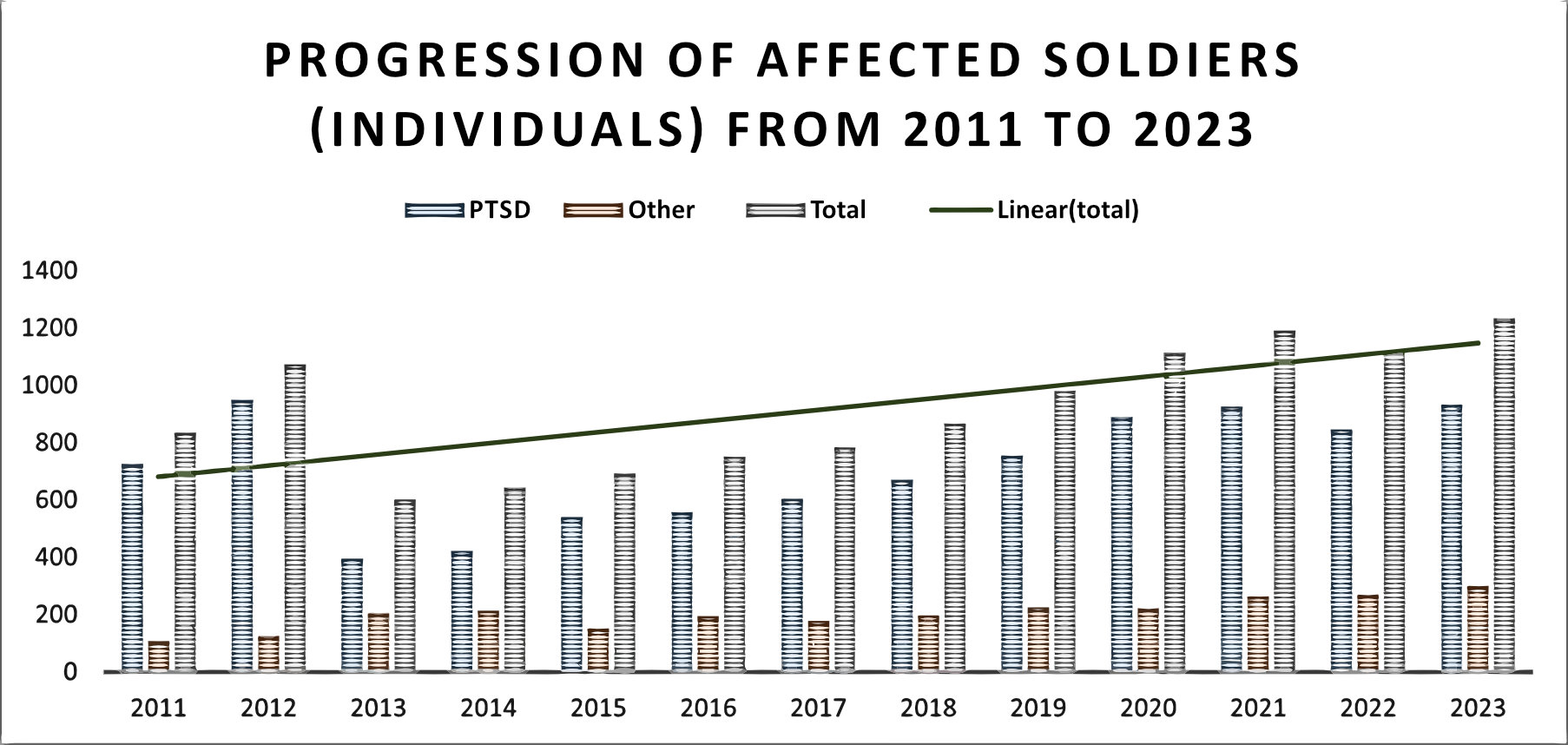
It is estimated that around three per cent of all soldiers on deployment suffer from PTSD, but only half of these cases are diagnosed.