Living with a post-traumatic stress disorder
Soldiers are exposed to particular stresses during foreign deployments. These can cause them to various mental disorders trigger, a Post-traumatic stress disorder (PTSD) or other psychological disorders resulting from deployment. Affected soldiers must then live with this for a more or less extended period of time – around the clock. Such a disturbance does not disappear. in a hurry and it cannot simply be switched off after work in one's free time.
Effects of psychological post-traumatic stress disorders on the lives of soldiers
- Hopelessness and powerlessness
- Self-reproach for having failed
- Self-accusations because the person concerned believes they have made a mistake themselves
- Feelings of guilt for having survived
- Tantrums because the event has just happened to you
- Outbursts of anger towards people who are blamed for the incident
Here you will find:
Out of misplaced shame, many soldiers endure suffering for far too long.
For those affected with a deployment-related mental illness the entire life situation can be extremely stressful be. They often wait with severe symptoms to the point of exhaustion from – sometimes for years.
They persevere because they fear these consequences above all else:
- disrespect for one's comrades
- a possible end to one's career
- Stigmatisation following a mental health diagnosis
In addition to the stresses of deployment, there may be further problems at home in a private setting find. For example, when the family grown apart during the long period of separation or cannot find a common way to live with the consequences of trauma. Soldiers often find it extremely difficult to cope with everyday life, both professionally and privately.
The attempt to, Wanting to solve all problems on your own often makes the situation more difficult for those affected.. Most people find it helpful to involve those around them in overcoming their problems. However, although it it is now known that even for PTSD, there are good treatment options with a chance of recovery, shy away from oneself many soldiers, the first step in Direction Help to do.
When experiencing psychological stress, the following thoughts in particular prevent people from going to see the military doctor:
- A soldier has to be strong. I am embarrassed that I need help, I am ashamed of it.
- Others might think I'm a wimp
- I am letting my comrades down if I cannot be deployed as widely as I could be because of restrictions on my use, or if I am temporarily released from duty for therapy.
- I am no longer as valuable in the unit with a mental disorder.
- I will be damaged stamped
Further information
A change in mindset is needed to accept help
Traumatised soldiers should be aware of one thing: It is perfectly normal to react psychologically to extremely stressful situations and experiences. And then it's good to get help so that you can get back to normal as quickly as possible. normal To be able to live life.
There are also good reasons for soldiers to accept help:
- Soldiers have a duty to maintain their health – including their mental health. They are acting in accordance with their duties and orders when they seek help from military doctors and specialists when necessary. There is no reason to feel guilty if the recovery process takes time.
- It is not unusual to have problems. After deployment, many soldiers in the German Armed Forces have expressed concerns about their mental health.
- Psychotherapy is not just for weak people or those unfit for military service. Treatment helps those affected to talk about their experiences and process traumatic memories. Afterwards, they feel better and stronger. With psychotherapeutic support, it is much easier to find your way back to full resilience in your professional and private life.
- Soldiers with PTSD are not automatically unfit for service. The stress disorder does not necessarily lead to incapacity for service (DU) or the end of a military career. In most cases, the condition can even be treated while continuing to serve in the country.
Further information
What happens to your career after suffering psychological damage in the line of duty
For soldiers, PTSD or other psychological damage sustained during deployment means not automatically the end of one's career. Depending on the status of the person affected, when the psychological post-traumatic stress disorder occurred, how long it has been affecting the person's performance and how severely, the following may apply various measures as well as various claims for financial benefits consider.
Basis for measures and claims following a psychological post-traumatic stress disorder form primarily following laws:
- Soldiers' Pensions Act (SVG)
- Deployment Supply Act (EinsatzVG) and Deployment Supply Improvement Act (EinsatzVVerbG)
- Reuse Act (EinsatzWVG)
Regulations, procedures and entitlements vary depending on the status of the Bundeswehr member concerned (professional soldier, former soldier, temporary soldier, civil servant, civilian employee).
The following are The most important procedures for soldiers with post-traumatic stress disorder briefly described:
Wehrdienstbeschädigung (WDB)
The military service disability procedure (WDB procedure) deals with the question of whether military service has caused damage to health that requires compensation. For active and former soldiers, the Federal Office of Personnel Management of the German Armed Forces (BAPersBw) is responsible for processing WDB applications. After various investigations involving medical records, statements and expert opinions, and taking into account the applicable legal provisions, a decision will be made as to whether there are recognisable consequences of damage and what the degree of damage (GDS) is. This is decisive in determining what entitlements exist under the Soldiers' Pension Act.
Transfer recommendation
In the context of PTSD, a transfer closer to home may be medically justified. This allows patients to engage more effectively in outpatient psychotherapy in familiar surroundings with supportive social structures and without the stress of commuting, thereby achieving healing or relief and successfully reintegrating into society within a protected environment. Soldiers must submit the relevant application to their respective disciplinary superior.
Temporarily unfit for duty (sick at home, KzH)
If performance is severely impaired or eliminated due to PTSD or another mental disorder, the military doctor or a psychiatrist from the British Armed Forces may temporarily KzH (Sick at home). However, it should be noted that, in the case of trauma-related disorders, prolonged periods of sick leave often have an unfavourable effect and tend to be detrimental to recovery.
Reintegration
If performance is reduced over a longer period of time, reintegration may be considered. To this end, the military doctor or a psychiatrist from the German Armed Forces certifies that the patient is entitled to a temporary reduction in daily working hours, for example five hours a day for five days a week for eight weeks or until a specific end date.
Term of protection
According to the Deployment Reuse Act, those affected by deployment are entitled to a protection period of up to eight years for professional qualification. The aim is to enable those affected to continue in employment. During and after the protection period, various provisions may apply. Here are a few examples:- During the protection period, personnel who have suffered damage in the line of duty may not be retired or dismissed on grounds of incapacity for service without their consent.
- Those who have suffered damage in the line of duty may be promoted during the protection period if they meet the career requirements and are in active service.
- Soldiers who have already left the service may, under certain conditions, be re-enlisted or transferred to a so-called special type of military service be imposed if damage caused by deployment is only recognised after their departure.
Further information
Effects of psychological post-traumatic stress disorders on the social environment
Psychological post-traumatic stress disorders are non-contagious. You have but massive impact on the living environment of those affected. In the course of PTSD, for example the behaviour, character and personality of the traumatised person can change significantly. This is felt most acutely by the people around him: close and distant family members, partners, children, friends, colleagues and comrades.
Fun-loving optimists become People who withdraw and only perceive the negative aspects of life. Confident and successful personalities mutate into helpless beings who no longer feel capable of coping with even the smallest difficulty. Loving fathers become angry and frightening men whom women and children are afraid of.
Everyone must first adjust to this new life situation and find a new basis for living together. Social support among family and friends is very important for people with post-traumatic stress disorder, because the promotes the healing process.
Further information
Dealing with traumatised people is not easy.
If a soldier shows symptoms of trauma after serving abroad, the people at home are initially unsettled. Close friends and family often do not know how to towards the person concerned should behave. Some people think that, help without interruption Some express their insecurity by getting into embarrassing situations. look away, while others react by completely withdraw.
The following tips will help you interact with someone who has a psychological disorder resulting from their service or PTSD:
- Learn as much as you can about the causes, symptoms and effects of PTSD. Only then will you be able to understand what the person affected is going through and why they sometimes behave in ways that are difficult to understand.
- Always remember that the behaviour of someone who has experienced trauma is a normal reaction to an abnormal event and not, for example, malice or disinterest towards you.
- Use words and your behaviour to convey to the person affected that they can trust you and that you are there for them when they need you.
- Keep reminding the person affected that their condition is not their own fault or failure, but a mental illness that they can do something about.
- Listen attentively when the person affected wants to talk about their experiences and feelings. However, do not pressure them to talk if they do not want to. You should not judge what you hear and should refrain from offering unsolicited advice. The person affected should be able to decide for themselves what they want to talk about, how much and for how long. Anyone who wants to hear what happened should also be prepared to hear terrible things.
- You should be accepting and patient if the person concerned is unreasonable about well-intentioned advice – for example, to consult a doctor – and does not follow it. Nevertheless, you should keep an eye on the person's state of health and repeatedly point out possible sources of help or offer your assistance in finding support.
- You should constantly keep an eye on your own mental well-being and seek professional help yourself if you realise that you are unable to cope with the situation.
Further information
Effects of psychological post-deployment disorders on relationships
As the closest confidants of soldiers, their partners are most affected by the consequences of post-traumatic stress disorder. A traumatic experience can significantly impair a soldier's ability to be emotionally there for their partner.
Foreign assignments are often for partnerships in itself already a test of endurance. It is not uncommon for partners to feel like strangers when they return. They have lived in different worlds for months and must first grow together again. All the more difficult will that be, when a partner returns from deployment with a traumatic experience. Feelings and behaviours that a partner with post-traumatic stress disorder may have and trigger can mean a great strain on a relationship.
Further information
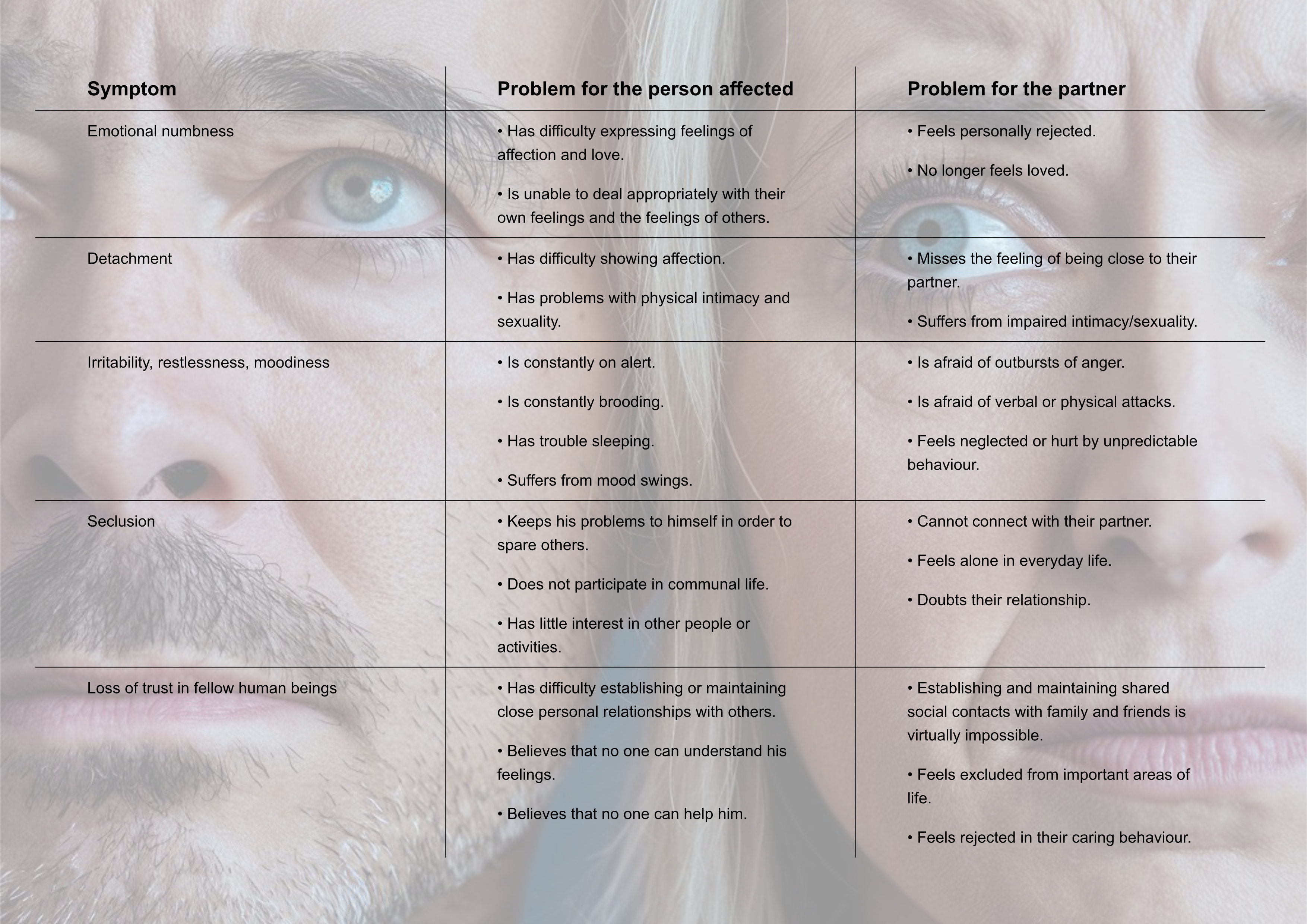
How partners can help with post-traumatic stress disorder
A partner and a partner with trauma Providing support means helping your partner to regain control of their own life. It does not mean taking all decisions, tasks and problems off your partner's hands.
By taking this approach, the partner shows their support:
Allow freedom
After returning from deployment, soldiers need time and space to process traumatic experiences and readjust to life at home. Partners should be understanding and ready to help if the soldier needs it, but should not impose themselves.
Be confident
For a shared future, it is beneficial to trust that your partner will recover and that their life situation will change for the better. This also means involving your traumatised partner in everyday tasks as much as possible and giving them the opportunity to make their own decisions. This prevents them from feeling alienated at home or losing the ability to cope with everyday life.
Convey security
In order to regain trust in themselves and in other people, it helps the affected partner if they can perceive their home as a safe place. To achieve this, it is important to keep promises, to show that you are committed to the relationship and stand by your partner, even if they do not always behave as you would like or expect them to.
Creating stability
Routine in everyday life makes it easier for those affected to regain control of their lives. Fixed meal and bedtimes can help, as can the distribution of tasks.
Express affection and support
A tender touch, a few kind words or small favours show your partner that you are there for them.
Be open to discussion
In order to be able to assess your partner's behaviour correctly, it is important to talk about feelings, frustrations and fears. The basis for a good conversation is mutual trust, treating each other's feelings with respect and showing compassion (not pity) when listening and talking. It is important to be able to listen to your partner when they want to talk about their experiences, but not to force them to talk.
Avoid injuries
Before a situation escalates and hurtful words are said or it even comes to blows, it is better to interrupt the conversation and take a break. The conversation can then be continued once the situation has calmed down again.
Redefining intimacy
The stress caused by PTSD can disrupt sexuality, tenderness and intimacy. In this case, it is important to discover and appreciate other forms of physical closeness. For example: hugging, kissing, holding each other in your arms.
Encourage
If the traumatised partner needs professional help, they should be repeatedly encouraged to accept offers of assistance. Supportive partners can help them find suitable services or accompany them to a counselling session.
Below, we have listed a few advice compiled, which make it easier to live with a partner who has been injured in the line of duty can:
- Be patient: it takes time to adjust to living with a traumatised partner. Even with psychotherapy, the symptoms of post-traumatic stress disorder do not disappear overnight.
- Do not take your partner's incomprehensible behaviour personally.
- Make compromises for the sake of harmony, but do not accept everything uncritically.
- Do not allow your life together to be dominated solely by the illness.
- Set your own limits for helpfulness and accommodation. Communicate these clearly to your partner and do not allow yourself to be persuaded to exceed these limits.
- Do not lose your sense of humour.
- Do not hesitate to seek professional help if you feel overwhelmed by the situation.
Possible sources of assistance in partnerships with mentally distressed soldiers may include:
- Relatives and friends,
- Partners of other soldiers,
- psychotherapeutic counselling centres,
- couples therapists,
- Self-help groups.
Further information
Partners must protect themselves
It requires strength and endurance., for a partner with a mental illness to be there. To prevent your energy from running out one day and your mental health from falling by the wayside, everyone should take care of their own wellbeing.
Many people do not dare to enjoy themselves when their partner is suffering. It is but It is important for everyone to stay healthy. If you are drained and exhausted yourself, you cannot help others.
Further information
- take regular breaks to relax
- Keep in touch with good friends and relatives
- do sports
- Do things that make you feel good, such as going to the sauna, taking a bath or reading a book.
Effects of psychological post-traumatic stress disorders on families and children
In a family with children and adolescents, living with the consequences of a parent's post-traumatic stress disorder is a major challenge for everyone. Each family member reacts to the changes in their own individual way.. This has an impact on the relationship structure between them. A family structure that has functioned well up to now can easily become unbalanced..
The sick person may feel like a stranger at home, no longer function as usual or as desired within the family unit. Many are no longer able to fulfil their previous role in the family as a partner, father or mother. They withdraw from family life, no longer take part in family celebrations or accompany their children to school activities.
In order to spare those affected from further stress, other family members take on their tasks, put their own needs aside and sometimes find themselves in emotional distress.
parents be able to due to one's own crisis management be overwhelmed by the task of raising children. Their own helplessness and disagreement between parents often lead to a Parenting style that has an unfavourable effect on children's development. Under excessive control or overprotective care, children grow up to become overly anxious or socially withdrawn personalities, for example.
Children may react with confusion and fear. the incomprehensible behaviour that their beloved father or mother suddenly displays.
In extreme cases, flashbacks occurring in the context of PTSD, for example, trigger aggressive behaviour in the affected parent, which can permanently disrupt family harmony or even lead to domestic violence. Such a situation overwhelms many families and can cause other family members to develop mental health problems.
Further information
Children must first learn to understand changes in the behaviour of a parent suffering from mental health issues.
The stress experienced by a parent with post-traumatic stress disorder can impair or negatively influence a child's development, but this is not necessarily the case. Whether a child is able to process their experiences with a mentally distressed parent without lasting damage depends to a large extent on how the mental distress is dealt with within the family.
The following table shows some examples of how dealing with mental health issues within the family can have a positive or negative effect on children.
Positive impact
Negative impact
A traumatised parent confuses a child's emotional world.
Children can have great difficulty classifying their feelings that arise in connection with the traumatised parent. The spectrum of their emotions ranges from loving, concerned and protective to annoyed, frightened or even angry.
Children often cannot understand why the traumatised parent no longer spends time with them or behaves aggressively towards them and other family members, for example.
Below are a few Examples listed, what feelings children of soldiers suffering from mental stress may have.
- Children feel neglected or no longer loved.
- Children suffer alongside their ill parent until they themselves become mentally ill.
- Children fear that their sick parent will no longer be interested in them, will no longer want to spend time with them or will no longer be able to care for them.
- Children feel guilty for the condition of their sick parent or the resulting problems in the family.
Children have an even greater problem than adults when it comes to recognising feelings, classifying them correctly, talking about them and seeking help when needed. However, learning this is very important for a child's emotional development. Parents with PTSD in particular are hardly able to deal adequately with their own feelings and those of other people. They are often only able to respond to their own children with emotional numbness.
Children can become ill themselves
If children are left alone with their feelings of helplessness, sadness, anger or fear, there is a risk that they will develop problematic behaviours. They may react by being disobedient, aggressive or withdrawn. Parents, in turn, often fail to recognise the distress their child is experiencing. Instead of responding with more affection, they react with reprimands or punishment. A vicious circle develops that soon becomes almost impossible to break.
Children who are affected by the psychological stress of a parent may exhibit the following reactions:
- They behave like the sick parent and display similar symptoms. For example, they are easily irritable, anxious or difficult to deal with. Behind this lies the need to develop a closer relationship with the sick parent.
- They take on some of the roles and responsibilities of the sick parent within the family. This can cause them to act too maturely for their age and feel overwhelmed.
- They display regressive behaviour and appear to regress in their development. Bedwetting, defiant behaviour and tantrums are examples of this.
- They relate the problems of their sick parent to themselves and believe that they are responsible for their parent's illness.
- They have problems at school or in their relationships within their circle of friends.
Further information
What helps children cope with a parent's mental illness
Children should receive plenty of care, love, security and attention within the family circle. At the same time, care must be taken to ensure that the child's development is not significantly disrupted by a parent's mental illness. This includes ensuring that the child attends school regularly and remains involved in school and other social activities with other children.
Freeing children from feelings of guilt: It is very important to make it clear to a child that the traumatised parent's behaviour is related to the trauma and is not the child's fault. Children should be given the opportunity and guidance to talk about their fears and concerns themselves. Parents must take these feelings seriously and accept them, and help the child to cope with the stress.
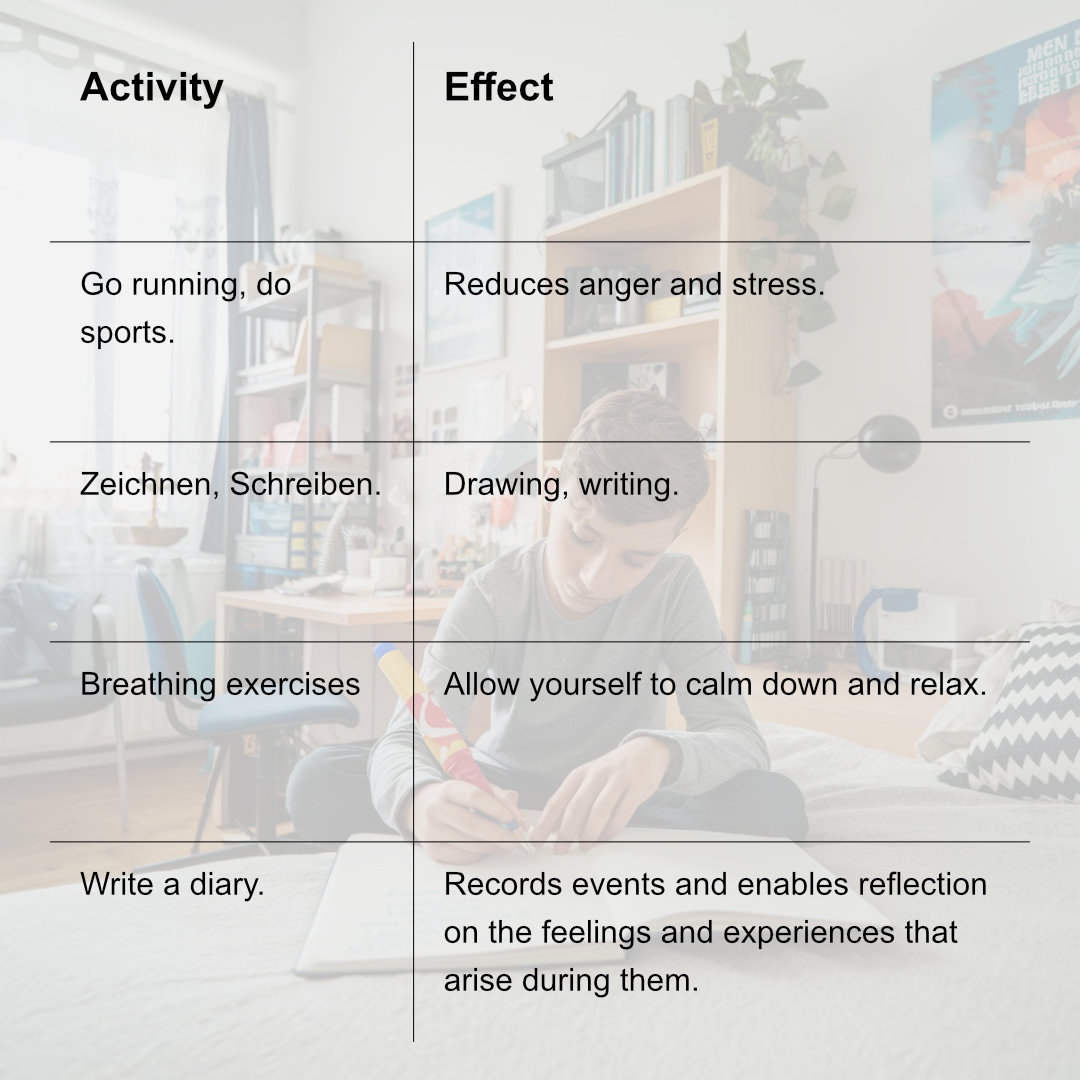
The following table lists some examples of activities that help children manage their stress:
Further information
- The child deliberately hurts, injures or cuts (scratches) themselves.
- The child is clearly about to hurt others.
- The child expresses thoughts related to suicide.
Providing children with security and stability: Familiar rituals can give children a sense of stability and security, especially in difficult times. Therefore, habits and routines within the family should be maintained as much as possible.
These rituals give children stability:
- a regular daily routine
- regular communal meal times
- joint activities within the family circle, for example, games afternoons or excursions
- Bedtime rituals
- Visits to the grandparents
Seek professional help: If children are unable to cope with the stress and show changes that give cause for concern, professional advice should be sought immediately from the family doctor, paediatrician or a psychosocial specialist.
These signs and symptoms indicate that a child needs professional help:
- difficulty concentrating;
- Problems participating in normal tasks or exercises at school;
- intense emotional reactions: for example, persistent crying, intense sadness, moodiness;
- depressive behaviour, being withdrawn or uncommunicative, speaking little;
- violent or depressive feelings, which may be expressed in „dark“ drawings or writings;
- significant increase or decrease in body weight;
- Lack of attention to personal appearance or hygiene;
- major changes in social activities or friendships;
- Drug and alcohol abuse.
Further information
Risks for relatives
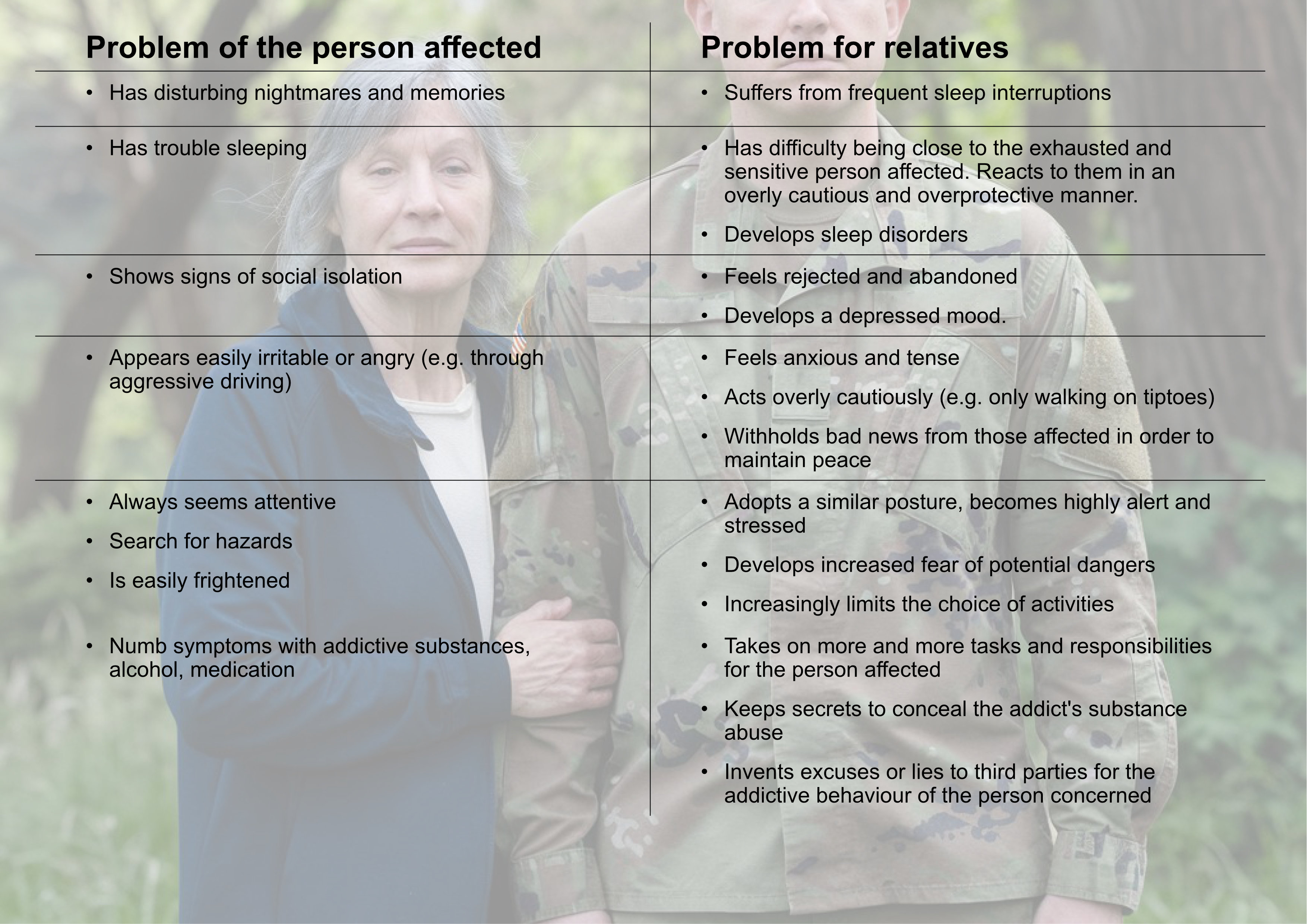
It may be that relatives of soldiers suffering from a psychological post-traumatic stress disorder develop similar symptoms to those exhibited by the affected person after a certain period of time. Relatives may adopt the bad habits of the affected person: smoking, drinking, an unbalanced diet, lack of exercise. Behind this lies the need to be close to the affected person or to keep them company.
In addition, symptoms of post-traumatic stress disorder can also have a negative impact on family members. The following table shows some examples of this.
When compassion fatigue sets in
Carers or nursing staff for sick people can apply for a compassion fatigue (in English Compassion fatigue). They then experience exhaustion, grief and suffering themselves, or become overly preoccupied with the suffering of the person they are caring for. Some symptoms of compassion fatigue can be very similar to those of PTSD.
In people who care for someone affected by post-traumatic stress disorder, compassion fatigue manifests itself in the following ways:
- They often think about their loved one, worry about them, and are upset about their traumatic experience.
- They suffer from sleep deprivation or disturbing dreams related to the trauma of their loved one.
- They feel exhausted or weak most of the time.
- You have difficulty falling asleep.
- You are easily irritated or annoyed, even by minor issues.
- Feeling hopeless, depressed, confined, angry about the state of one's life.
- They feel less compassion and interest for others.
Preventing compassion fatigue
To prevent compassion fatigue, the caregiver should Take regular breaks from stressful situations and practise self-care.. This includes focusing on your own well-being as often as possible and spending time on activities and with people who are good for your soul.
Important self-care measures include
- ensure sufficient sleep;
- pay attention to healthy eating;
- Regular exercise: just 10 minutes of exercise a day can reduce stress and boost your energy levels.
In addition, it is advisable to regularly assess your own well-being and, if necessary, Possibilities for relief to search.
Measures to ease the burden of coping with everyday life can include:
- ensure sufficient sleep;
- pay attention to healthy eating;
- Regular exercise: just 10 minutes of exercise a day can reduce stress and boost your energy levels.
In addition, it is advisable to regularly assess your own well-being and, if necessary, Possibilities for relief to search.
Sharing responsibility
You don't have to do everything on your own. Usually, there are people in your family or circle of friends who are willing and able to take on some of the responsibility and tasks.
Simplify tasks
There may be ways and means of simplifying daily routines.
Find balance
Spiritual, religious, or voluntary activities help many people find comfort, meaning, and a sense of connection.
Learn
Participating in courses such as stress management, aggression management, couple communication or parenting seminars can provide perspectives for dealing with problems more effectively.
Further information
Domestic violence
Trauma can cause the affected person to lose control of stressful emotions such as anger or rage and hurt themselves or others. This can lead to verbal or physical aggression: loud shouting, pushing or shoving. This behaviour is known as domestic violence falls.
Violent assaults should never be excused or tolerated. Not even if the person who becomes violent is under psychological stress. Nevertheless, domestic violence often goes unreported for a long time. In many cases, a spiral of apologies and reconciliation followed by renewed outbreaks of violence ensues before the victim finds the courage to call the police or seek other forms of help.
For their own safety, family members of a person prone to violence should definitely develop an emergency plan so that they can react quickly in an emergency. It is important to practise the measures and regularly check that they are suitable for use in real life.
The following overview lists the most important Key points for an emergency plan in cases of domestic violence listed:
- Find a safe place in your home that you can go to when a conflict becomes too heated.
- Avoid places where there are potentially dangerous objects, such as the kitchen.
- Avoid places that have no exit, such as a bathroom or a closet.
- Think of a code word that can serve as an emergency signal for people you trust. Tell these people in advance that they should get help immediately as soon as you use this code word.
- Pack a bag with essential items in case you need to leave quickly. This should include: copies of important documents such as ID cards, driving licence, health insurance card, birth certificate and, if applicable, medical records documenting previous injuries. Set aside some cash. Hide all these items in a place where your partner cannot find them.
- Make a list of people and organisations you can call in an emergency. Memorise important telephone numbers in case you do not have your own telephone with you.
- Confide in someone. You do not need to discuss the details, but it is beneficial to have someone who understands the basics of your situation and whom you can turn to for support in the future.
- Consider whether you might want to arrange with your neighbours that they should call the police if they hear loud noises or an argument coming from your flat.
- Consider whether you want to speak to a supervisor at your workplace so that they can help you with safety planning at work.
If there are children in the household, safety precautions should also be taken for them:
- Tell your child about a safe place they can go to when conflicts at home become heated. Practise escape routes with your child.
- Teach your child who to call in an emergency. Help them memorise important emergency telephone numbers. Explain very clearly how and when to get help.
- Some children may try to intervene in an argument or fight between their parents in order to protect one parent. This puts the child at risk of being hurt themselves. Teach your child not to get involved in an argument. Tell your child what to do if a serious argument breaks out: go to a safe place and call emergency numbers.
- Talk to the child and listen to them. Most children want an opportunity to talk about how they feel. Try to talk honestly about the situation without frightening the child. A child wants to be sure that they can believe and trust you.
- Explain to the child that the violent altercation is not their fault and that they are not responsible for the behaviour of adults.
- Keep reminding the child that violence is wrong and does not solve problems.
- Seek help for the child if you are unable to resolve conflicts within the family yourself.