Guide
Soldiers affected by PTSD or other post-traumatic stress disorders, as well as their families, often find themselves in situations where they do not know how to behave appropriately. With our Guide we would like to give you some specific suggestions, how to act appropriately in typical situations.
How PTSD and other psychological conditions resulting from deployment can be communicated when interacting with other people
It often happens in partnerships or within the family circle that uncertainties, when it comes to, how the psychological trauma of a soldier should be communicated in contact with other people. Some people show little interest in the affected person's well-being, others constantly expect detailed information and explanations, and still others are irritated when the affected person exhibits incomprehensible behaviour in their presence.
The following Three principles make it easier to deal with post-traumatic stress disorder:
- Mental illness is nothing to be ashamed of.
- You are not obliged to provide anyone with personal information about your state of health or that of your partner or relatives if you do not wish to do so or if you feel uncomfortable doing so.
- It is very helpful to establish a common approach within a community on how to explain the mental illness of a member of the community and the resulting behaviours to other people.
These possibilities there is, how mental illness can be communicated to others:
- The illness and its symptoms are discussed openly with everyone.
- Only a few trusted individuals are told openly about the illness and its symptoms; other people are given only vague information.
- The illness is kept secret as far as possible.
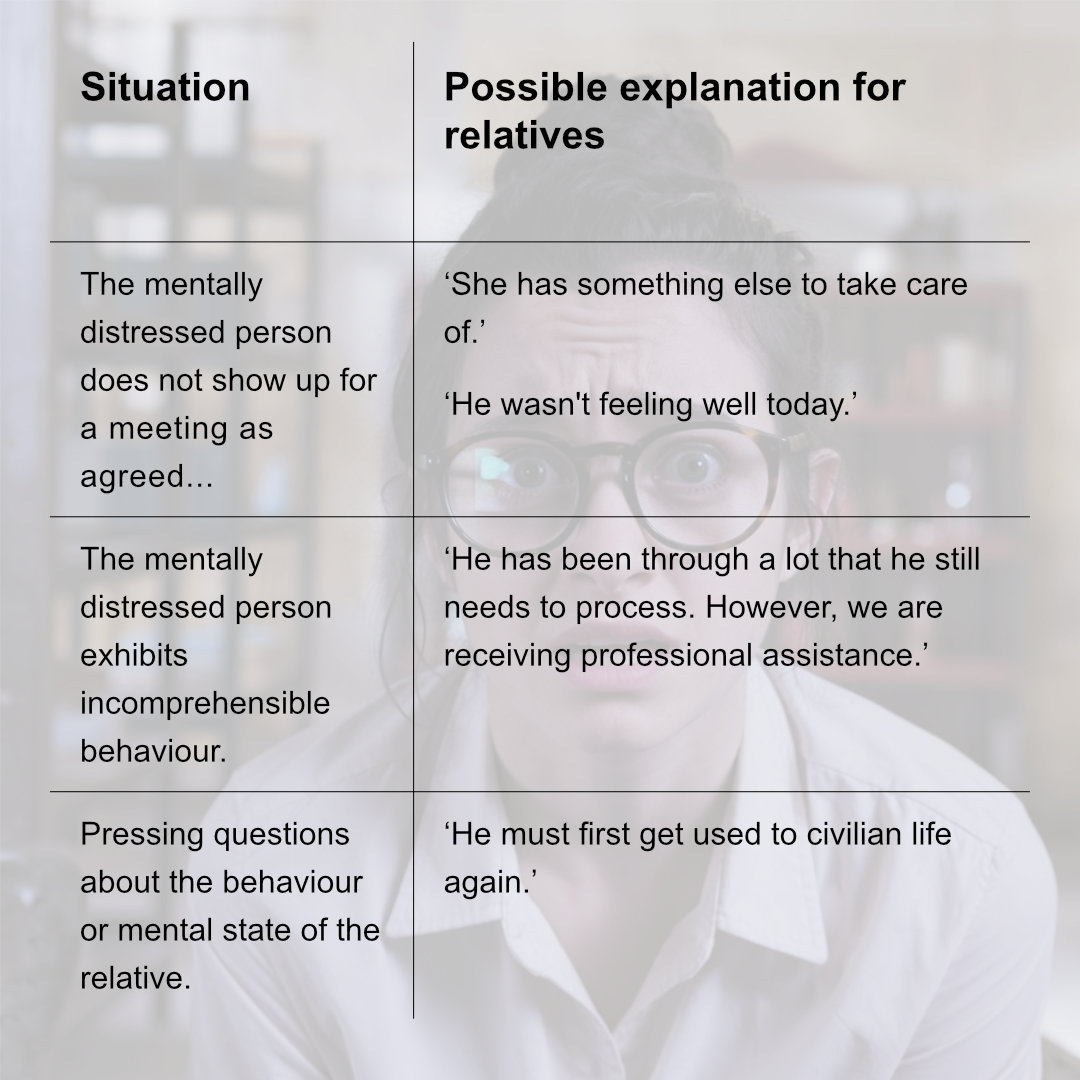
The following table shows some typical situations named, in which there is often a need to explain oneself to other people in everyday life and what reactions are possible.
Here you will find:
Further information
- does not show any understanding for your situation in the long term,
- Abusing your trust, for example by passing on confidential information,
- It lets you down several times despite promising support.
How to deal with social withdrawal
The symptoms of PTSD or other psychological disorders resulting from deployment usually include withdrawal from social environments. Partners and family members affected female soldiers and soldiers are then often faced with a dilemma. On the one hand would like they continue to do things together with the person who is ill. On the other hand, they fear that the person affected could embarrass them in public by, for example, displaying anxiety, irritability or other behaviour that they find shameful. Out of concern for the person affected, however, they are also reluctant to leave them alone in order to maintain their own social contacts. As a result, relatives often find themselves socially isolated.
These measures can help overcome social withdrawal.:
Spend as much time as possible with family and friends.
This could be a social and enjoyable gathering, such as a meal together, an outing or an afternoon of games. Such gatherings often provide an opportunity for personal conversation. Encourage the person with dementia to take part in such meetings.
Encourage the sick person to get in touch.
For soldiers, it can be a great help to have contact with active and former comrades, because they are the ones who are most likely to understand them.
Take advantage of opportunities for social interaction.
Clubs and other groups offer a great opportunity to regularly meet people who share your interests. These could be sports groups, choirs, religious communities, neighbourhood gatherings or get-togethers with other families at the playground. You can also expand your network by volunteering or getting involved in politics.
Find support in a self-help group.
Self-help groups bring together people who have the same problem and want to do something about it. Such self-help groups also exist for family members of soldiers. Information on relevant services is available from family support contact points, such as the Social services of the German Armed Forces or the Protestant Working Group for Soldier Support. or the Catholic Working Group for Soldier Support e. V.
Further information
How to deal with sleep problems
PTSD and other psychological disorders resulting from deployment often lead to sleep disorders. Those affected have nightmares, make loud noises in their sleep or sleep very little at night. In such an environment, it is also difficult for relatives to sleep well.
If you feel disturbed by your partner while sleeping, it is best to try the following measures:
- If you are annoyed: Always remember that your relative has sleep problems due to a traumatic experience. They are not behaving this way to annoy or disturb you.
- For frequent sleep disturbances: Sleep in separate rooms from time to time. However, you should then ensure that you find other times and ways to be physically and emotionally close.
- Does your partner frequently startle awake during the night? Help him relax by speaking gently to him and explaining that he is safe at home.
- If your measures do not help: Ask your partner how you can help them sleep better.
- Do you suffer greatly from sleep disorders? Talk to a doctor or psychotherapist about this.
Sometimes relatives sleep poorly or not at all because they are worried about their loved one.
Then this will help:
- Try to discuss your concerns with your partner.
- Write down your worries and leave them alone until the next morning. In most cases, you will then find a solution yourself, or you will be able to deal with the problem thoroughly and then find a solution.
In general, everyone can do something to ensure a good night's sleep. The most important measures for healthy sleep are:
Switch off
Before going to bed, you should consciously create a calm period of relaxation that facilitates the transition from daytime activity to night-time rest. Possible rituals include drinking a cup of tea, reading or listening to relaxing music. It is important to shake off the excitement and tension of the day so that sleep can develop naturally.
Alcohol
Alcoholic beverages can have a relaxing effect and cause people to feel drowsy and sleepy. However, when the alcohol is broken down during the night, the opposite effect occurs and sleep becomes restless and disturbed. It is better for healthy sleep to avoid alcohol in the evening.
Food
When you fall asleep, your digestive system slows down. Eating heavy meals close to bedtime can cause stomach upset and heartburn during the night. You should not eat anything four hours before going to bed. If you are hungry, a light snack is recommended.
Excitement
Before going to bed, any kind of excitement should be avoided, such as arguments or watching horror films.
Caffeine
Caffeinated drinks such as coffee, cola, black tea or energy drinks can remain effective for four to five hours after consumption. They should therefore not be drunk shortly before going to bed.
Nap
Sleeping during the day disrupts your natural sleep pattern. You may then not be tired enough at bedtime in the evening.
Nicotine
Nicotine leaves the body about two hours after it is inhaled. To prevent nicotine cravings in the middle of the night, it is best to stop smoking at least two hours before bedtime. It is even better to quit smoking altogether.
sleeping pills
Sleeping pills should only be taken in consultation with a doctor. Sleeping pills can be addictive if taken over a long period of time. Some medications can cause sleep disorders when taken long-term.
Sleeping environment
A sleep-promoting sleeping environment should be quiet, dark, comfortably temperate (14° to 18° Celsius) and safe. Noise and light – even dimmed light – can disturb or shorten sleep.
You should not engage in activities in bed that you would normally do while awake. These include reading, watching television, eating, studying, talking on the phone or using your laptop. Otherwise, your brain could become trained to stay awake in bed.
Sleeping time
Only go to bed when you feel tired in the evening, and get up at the same time every morning.
Sport
Sport can both promote and disrupt sleep.
Keeping an eye on time
Keeping an eye on the time when you want to fall asleep or wake up at night creates pressure. Alarm clocks and other clocks should be removed from view during the night.
Further information
How to deal with anger and annoyance
Anger and irritation are feelings that people affected by post-traumatic stress disorder often struggle with. This can also put strain on family members and cause them to become angry themselves.
Family members may feel anger, because
- the traumatic experience ever happened;
- the trauma also affects their lives;
- your relative has had to give up their job and/or there has been a loss of income;
- your relative drinks too much, spends too little time with you, or is angry and easily irritated most of the time due to their mental illness;
- your relative is constantly preoccupied with the trauma;
- they bear additional responsibility due to the mental illness of their relative.
When you are angry, you cannot think clearly. It is difficult to have a conversation and feel understood when you are upset. You and your loved one can put the anger behind you when you understand that no one is to blame for these feelings.
The following measures help to defuse situations in which anger and annoyance make it difficult to interact with one another.
- Do not take moody and difficult behaviour personally.
- Do not blame yourself for someone else's anger. Always remember that you are not the cause of your loved one's anger.
- If you notice that you are becoming increasingly angry during a conversation with the other person, take a break and leave the room for a while. This can help both of you to calm down. Afterwards, it is usually possible to resume a constructive conversation about the difficulties you are experiencing with each other.
How to deal with drugs and alcohol
Some people try to numb their problems with alcohol or drugs after experiencing trauma.. This puts them at risk of becoming dependent on the substance in question. This often leads to additional problems in everyday life and in their interactions with others.
It is not uncommon for relatives to resort to alcohol and drugs as well., to escape the difficulties they have with the person affected. Or they want to keep the relative company and be close to them when they use their addiction to escape their trauma-related memories and feelings.
Anyone who realises that they are caught in a vicious circle of addiction device should act promptly and take countermeasures.
If you are concerned that you are losing control over your responsible use of alcohol and drugs, you should do the following:
- Be aware that alcohol and drugs will not solve your problems.
- Refrain completely from consuming alcohol and drugs, or drastically reduce your consumption.
- If you are unable to limit your consumption of addictive substances on your own, seek help from relatives, friends, a self-help group, a professional counsellor or a doctor.
Further information
How to deal with anxiety
People with traumatic experiences often feel tense. They are always on guard and are primarily concerned with making their living environment a safe zone. If a person is overly preoccupied with potential dangers, this can rub off on the people around them. Then they too can become permanently insecure.
Some typical fears experienced by relatives of soldiers with a deployment-related mental illness, are listed below:
- They are afraid when the traumatised person becomes angry or aggressive, especially if they fear becoming the target.
- They fear that there will be restrictions in terms of time spent together, closeness and intimacy.
- You lose hope that your family will ever return to normal if the illness persists for a long period of time. This can lead to despondency, depression and feelings of grief and loss.
The following measures may help, such Counteracting fears:
- Encourage the relative to seek professional help for the treatment of their psychological post-traumatic stress disorder.
- Consider couples or family therapy if difficulties arise within the family environment.
- Learn relaxation techniques to help you face anxiety-provoking situations with greater composure.
- Maintain a healthy lifestyle with regular physical activity and a balanced diet. This fundamentally strengthens your physical and mental resilience.
How to deal with embarrassment and shame
As a result of a psychological post-traumatic stress disorder, the affected person may behave in a way that causes embarrassment to their relatives when meeting with family or friends or in public. If it happens for example, in the context of PTSD Outbursts of anger, flashbacks or other symptoms cause embarrassment or shame, especially among family members who see such a condition as a sign of weakness.
Embarrassment and shame can cause those affected and their relatives to withdraw and keep their problems to themselves. However, this strategy usually fails. It leads to isolation, leaving people without sufficient support.
The following measures can help, Overcoming embarrassment and shame:
- Always remember: post-traumatic stress disorder is an illness that can cause normal reactions to extremely stressful events. It is nothing to be ashamed of.
- Talk as openly as possible about the difficulties that arise for the person affected and for you as a result of the post-traumatic stress disorder.
- Stand by the person affected and support them as best you can in their recovery.
- Do not allow others to force you into a defensive position where you feel compelled to apologise for your relative.
How a conversation about the traumatic experience can arise
Soldiers who have experienced trauma are generally reluctant to discuss their experiences. However, relatives usually want to know exactly what happened and how their loved one is doing.
The following measures can help, to engage in a conversation about the traumatic experience:
- Show understanding for their feelings and emotional reactions.
- Identify your counterpart's strengths and acknowledge their efforts to cope with the traumatic event.
- Accept that the focus is on your conversation partner's experiences and refrain from referring to your own experiences.
- Only give advice when asked.
- Refrain from making comments that minimise or undermine your loved one's experience. Such comments could include: „That was so long ago, you should look ahead,“ „Everything will be fine,“ or „Life goes on.“.
- Do not judge the decisions made by the other person. The stress of working in life-threatening situations is difficult for civilians to comprehend.
Also With your body language, you can send positive or negative signals.to the person you are talking to send.
Some examples:
Signals attention
- nodding one's head,
- repeatedly saying „hmm“ or „a-ha“,
- Regular eye contact that is neither constant nor fleeting.
Motivated to continue talking
Questions that cannot be answered with just one word – usually yes or no.
Examples:
„How are you?“ instead of „Are you well?“
„How was that for you?“ instead of „That must have been difficult for you?“
Unsettled
- Facial expression: raise eyebrows,
- roll one's eyes.
How to communicate well in a relationship
Partners are often the closest confidants of soldiers suffering from post-traumatic stress disorder. Their ability to listen and talk is particularly important when it comes to understanding those affected and helping them to express their own concerns and needs.
The following tips can help, to remain in contact.
Tips for good communication between partners
- Express your feelings in words. Your partner may not know that you are sad or frustrated unless you clearly express your feelings.
- Help your partner put their feelings into words. For example, ask if they are angry, sad or worried.
- Be a good listener: do not argue or interrupt.
- Ask how you can help in concrete terms.
- Do not give advice unless you are asked for it.
Tips for fair argumentation
- When the other person is speaking, listen without interrupting.
- Ask questions.
- If necessary, repeat what has been said to ensure that you have understood correctly.
- Do not make any below-the-belt comments, for example about the other person's appearance. Concentrate on the current topic of conversation and the person in front of you.
- Do not discuss matters with each other when you are in bed. The bedroom should be a place for expressing mutual affection. It is better to use another, neutral room for discussions.
- Refrain from making sweeping statements and concentrate on the matter at hand.
- Work together as a team to solve problems. Together, you can achieve much more than you could on your own.